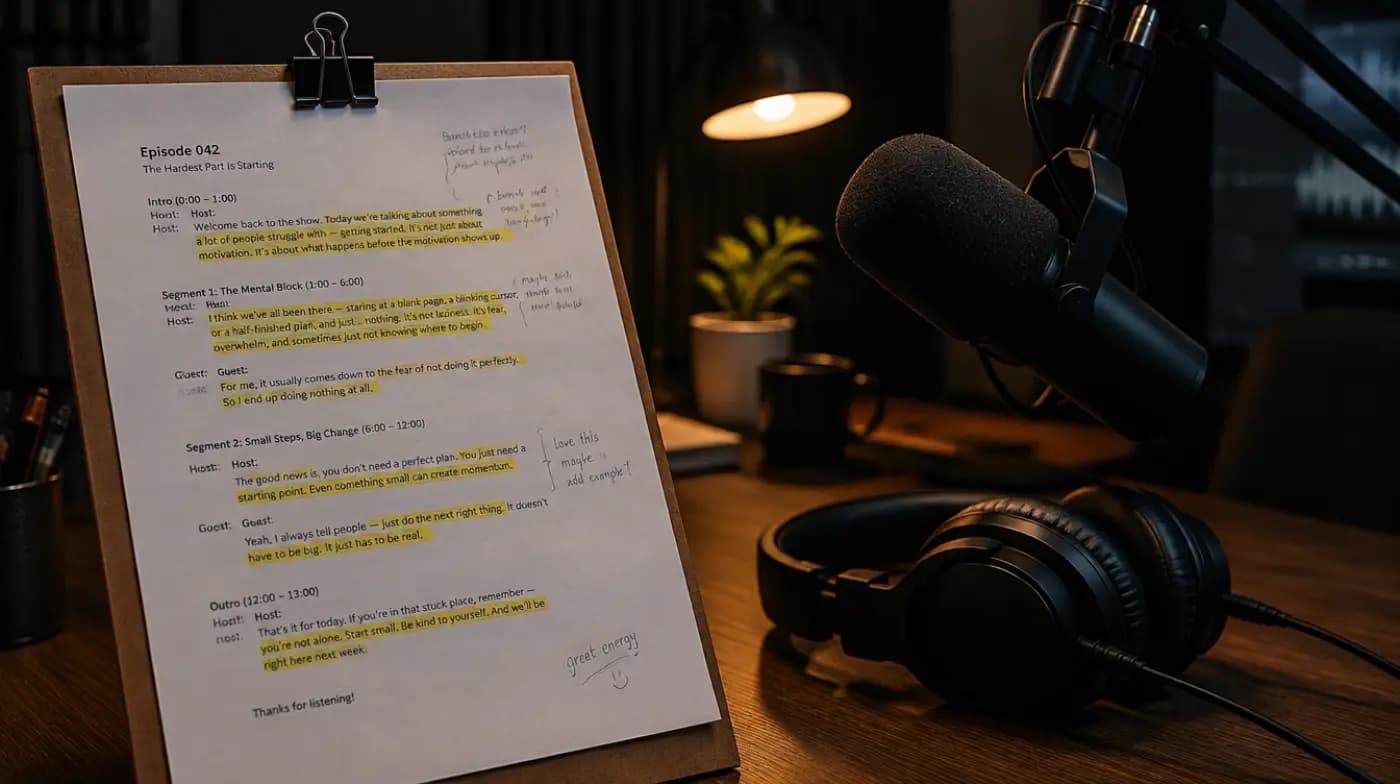

Most podcasts that sound relaxed and natural are not improvised. The host knows exactly how the episode opens, where it goes next and how it ends, even if the middle sounds like a free-flowing conversation.
That structure comes from a podcast script template. Below are four free templates you can copy straight into your notes app: a solo episode, an interview episode, a co-hosted episode and a narrative episode. You will also find a podcast intro script, an outro script, a sponsor read and a short outline template for when you do not need a full script.
What should a podcast script template include?
Every format below uses the same building blocks. Once you know them, you can adapt any template to your show.
- Cold open or hook. A line or short clip that tells listeners why to keep listening.
- Intro. Show name, who it is for and what this episode covers.
- Main segments. Usually two to four, each with one clear point.
- Transitions. Short lines that move listeners from one segment to the next.
- Ad or announcement. Optional, usually in the middle or near the start.
- Call to action. One specific thing for listeners to do.
- Outro. A recap, a preview of the next episode and a sign-off.
Tip: Write for the ear, not the eye. Use short sentences, contractions and words you would actually say. Read every scripted line out loud before you record it.
Template 1: Solo episode script template
Use this for teaching, commentary or "how-to" episodes where you are the only voice. It assumes a 15 to 25 minute episode.
SOLO EPISODE SCRIPT TEMPLATE

EPISODE: [Number] – [Title that names the problem or promise]
TARGET LENGTH: [__] minutes

[COLD OPEN – 15 to 30 seconds]
"[A surprising statement, question or short story that sets up the problem.]"

[INTRO MUSIC – 5 to 10 seconds]

[INTRO – 30 seconds]
"Welcome to [Show Name], the show for [listener] who want to [outcome].
I'm [Your Name]. Today we're talking about [topic], and by the end
you'll know [specific takeaway]."

[SEGMENT 1: THE PROBLEM – 3 to 5 minutes]
- Why this matters: [point]
- What most people get wrong: [point]
- Example: [short, clearly hypothetical or your own story]

[TRANSITION]
"So if that's the problem, what actually works? Here's what I'd do."

[SEGMENT 2: THE SOLUTION – 6 to 10 minutes]
- Step 1: [action + why]
- Step 2: [action + why]
- Step 3: [action + why]

[SEGMENT 3: OBJECTIONS OR MISTAKES – 3 to 5 minutes]
- "You might be thinking [objection]. Here's my answer: [answer]."
- Mistake to avoid: [point]

[CALL TO ACTION – 30 seconds]
"This week, try [one specific action]. If it helps, [follow the show /
leave a rating / reply to the newsletter]."

[OUTRO – 30 seconds]
"Quick recap: [one-sentence summary]. Next time, we're covering [topic].
Thanks for listening to [Show Name]. I'm [Your Name]. See you next week."

[OUTRO MUSIC]
Template 2: Interview episode script template
Interview shows rarely need a full script. Script the opening, the guest introduction, the ad and the close, then outline the conversation with questions.
INTERVIEW EPISODE SCRIPT TEMPLATE

EPISODE: [Number] – [Guest Name] on [Topic]
GUEST: [Name], [role], [book/company]
TARGET LENGTH: [__] minutes
LISTENER TAKEAWAY: [What listeners should leave with]

[COLD OPEN – best 15 to 30 second clip from the interview, added in editing]

[INTRO MUSIC]

[HOST INTRO – 45 seconds]
"Welcome to [Show Name], where [one-line show promise]. I'm [Host].
My guest today is [Guest Name]. [He/She/They] [one-sentence credential
that matters to listeners]. [His/Her/Their] new book, [Title], is about
[one-line summary]. We talk about [point 1], [point 2] and [point 3].
Here's my conversation with [Guest First Name]."

[CONVERSATION OUTLINE]
WARM-UP (2 to 3 min)
- Icebreaker: [question tied to something you found in research]

BACKGROUND (5 min)
- [Origin question]
- [Turning-point question]

CORE (15 to 25 min)
- [Expertise question 1]
- [Expertise question 2]
- [Ask for a specific example]
- [Question about a common mistake]
- MUST ASK: [the one question this episode exists for]

[MID-ROLL AD OR ANNOUNCEMENT – see ad read template]

DEPTH (5 min)
- [Reflective question]

LIGHT (2 to 3 min)
- Rapid-fire: [3 to 5 quick questions]

CLOSE (2 to 3 min)
- "What's one thing listeners can do this week?"
- "Where can people find you and the book?"

[HOST OUTRO – 30 seconds]
"Thanks to [Guest Name]. You'll find [book/links] in the show notes.
If you enjoyed this, [specific call to action]. Next week: [preview].
I'm [Host], and this has been [Show Name]."
If you need questions to fill the outline, our list of 126 podcast interview questions is grouped by stage, so you can drop them straight into each section.
Template 3: Co-hosted episode script template
Co-hosted shows live or die on chemistry, so script as little as possible. The template gives you a running order and assigns roles so you do not talk over each other.
CO-HOSTED EPISODE SCRIPT TEMPLATE

EPISODE: [Number] – [Title]
HOSTS: [Host A] (leads), [Host B] (reacts / pushes back)
TARGET LENGTH: [__] minutes

[COLD OPEN – a 20 second exchange or a funny moment, picked in editing]

[INTRO MUSIC]

[INTRO – Host A]
"Welcome to [Show Name]. I'm [Host A]."
[Host B]: "And I'm [Host B]."
[Host A]: "Today we're [debating / ranking / breaking down] [topic]."

[CATCH-UP – 2 to 3 min, keep it short]
- One quick personal update each

[SEGMENT 1 – Host A leads – [__] min]
- Topic: [point]
- Host B's angle: [counterpoint or question]

[SEGMENT 2 – Host B leads – [__] min]
- Topic: [point]
- Host A's angle: [counterpoint or question]

[RECURRING SEGMENT – [__] min]
- [Listener question / ranking / "win of the week"]

[CALL TO ACTION – Host B]
"Tell us where you land on this. [How to reach the show]."

[OUTRO – Host A]
"That's the show. Next week: [preview]. I'm [Host A]."
[Host B]: "I'm [Host B]. See you then."
Tip: Agree in advance who wraps each segment. Most rambling in co-hosted shows comes from both hosts waiting for the other to move on.
Template 4: Narrative or storytelling script template
Narrative episodes are fully scripted. This template follows a simple story structure: set the scene, raise a question, complicate it, then resolve it.
NARRATIVE / STORYTELLING SCRIPT TEMPLATE

EPISODE: [Number] – [Title]
STORY QUESTION: [The question listeners want answered by the end]
TARGET LENGTH: [__] minutes

[COLD OPEN – 30 to 60 seconds]
NARRATOR: "[Drop listeners into a vivid moment, mid-action.]"
[SOUND: ambient sound or music that sets the scene]

[TITLE / THEME MUSIC]

[ACT 1: SETUP – [__] min]
NARRATOR: "[Who is this about? Where and when are we?]"
CLIP: [Interview clip, Source, timestamp]
NARRATOR: "[State the story question clearly.]"

[ACT 2: COMPLICATION – [__] min]
NARRATOR: "[What went wrong, or what made it harder?]"
CLIP: [Interview clip, Source, timestamp]
NARRATOR: "[New information that changes how we see the story.]"
[MUSIC BED]

[ACT 3: TURNING POINT – [__] min]
NARRATOR: "[The decision or event that changed everything.]"
CLIP: [Interview clip, Source, timestamp]

[ACT 4: RESOLUTION – [__] min]
NARRATOR: "[Answer the story question. What happened, and what it means.]"

[REFLECTION – 1 min]
NARRATOR: "[Why this story matters to the listener.]"

[CREDITS AND OUTRO]
NARRATOR: "[Show Name] is produced by [names]. Next time: [teaser]."

SOURCES: [List every source and fact for checking before recording.]
Keep a list of sources at the bottom of every narrative script. Fact-checking before you record is far easier than re-recording after.
How do you write a podcast intro script?
Your intro should be short, consistent and specific. Many hosts keep the show part identical every week and change only the episode line.
PODCAST INTRO SCRIPT (about 30 seconds)

"[Hook: one line about this episode's problem or story.]

Welcome to [Show Name], the podcast for [specific listener] who want to
[outcome]. I'm [Your Name], [one-line credential].

Today, [what this episode covers], and you'll walk away with
[specific takeaway]. Let's get into it."
Short version for interview shows:
"This is [Show Name]. I'm [Host]. Today, [Guest] on [topic],
and why [surprising angle]. Here we go."
How do you write a podcast outro script?
PODCAST OUTRO SCRIPT (about 30 seconds)

"That's it for this episode of [Show Name]. The one thing to remember:
[one-sentence takeaway].

If this was useful, [one call to action: follow the show / share it with
one person / leave a rating]. Links to everything we mentioned are in
the show notes.

Next time, [preview of the next episode]. I'm [Your Name]. Thanks for
listening."
Ask for one action, not five. A list of requests usually gets none of them done.
How do you script an ad read or sponsor segment?
A host-read ad works best when it sounds like your normal voice and makes the sponsor relationship clear. The FTC's endorsement guidance says that when an endorsement is made audibly, the disclosure should be made at least audibly, so say it out loud rather than relying on show notes.
SPONSOR / AD READ TEMPLATE (60 seconds)

[DISCLOSURE]
"This episode is sponsored by [Sponsor]."

[PROBLEM]
"If you've ever [problem your listeners have], you know [pain point]."

[PRODUCT]
"[Sponsor] [what it does] so you can [benefit]."

[PERSONAL NOTE – only if true]
"I've used it for [how you actually use it]."

[OFFER AND CALL TO ACTION]
"Go to [URL] and use code [CODE] for [offer]. That's [URL], code [CODE]."

[TRANSITION BACK]
"Now, back to [topic/guest]."
The same structure works for promoting your own book, course or newsletter. Swap "sponsored by" for "this episode is brought to you by my new book" and keep it under a minute.
Should you script fully or use a podcast outline template?
Scripting everything gives you control but can sound stiff. Outlining sounds natural but can wander. Most shows mix the two.
| Part of the episode | Script word for word | Outline with bullets |
|---|---|---|
| Cold open and hook | Yes | |
| Intro and outro | Yes | |
| Ads and announcements | Yes | |
| Solo teaching segments | Optional (first few episodes) | Yes, once you are comfortable |
| Interview conversation | Yes | |
| Co-hosted discussion | Yes | |
| Narrative storytelling | Yes |
When an outline is enough, use this one-page podcast outline template:
PODCAST OUTLINE TEMPLATE

Episode title:
Listener takeaway (one sentence):
Hook:
Segment 1 – point + example:
Segment 2 – point + example:
Segment 3 – point + example:
Call to action:
Next episode preview:
Target length:
Key takeaway: Script the edges of the episode and outline the middle. Exact words matter most in the first 30 seconds, the ads and the last 30 seconds.
How do you make a scripted podcast sound natural?
- Write the way you talk. Read your draft aloud and rewrite anything you would never say in conversation.
- Mark pauses and emphasis. Use a slash for a breath and bold for words to stress.
- Practice once before recording. A single read-through catches most tongue-twisters.
- Stand up or smile. Many hosts find their delivery has more energy when they are not slumped in a chair.
- Leave room to go off script. If a better line comes to you while recording, use it.
What to do next
Pick the template that matches your format and use it for your next three episodes, adjusting as you go. By episode three you will know which parts to keep scripted and which to loosen.
If you are still at the planning stage, our guide on starting a podcast step by step covers equipment, hosting and getting listed, and our list of podcast topic ideas can fill your episode calendar. If you host an interview show and want well-prepared guests, we can introduce nonfiction authors to your podcast at no cost.