
Starting a podcast is cheaper and simpler than it looks from the outside. The hard part is not the microphone or the software. It is choosing a show idea narrow enough that the right listeners care, then publishing on schedule long enough for them to find you.
This guide covers how to start a podcast from the first idea to episode 20: niche, format, name, equipment, recording, editing, hosting, getting listed on Apple Podcasts and Spotify, launching, and growing. There is a section on starting for free, and one on making money, so you can decide how much to invest before you spend anything.
How to start a podcast: what are the steps?
Here is the whole process at a glance. Each step has its own section below.
- Choose a niche and a specific listener.
- Pick a format: solo, interview, co-hosted or narrative.
- Name the show and write a one-line description.
- Create cover art.
- Get basic equipment.
- Set up a quiet recording space.
- Record your first episodes.
- Edit and add an intro and outro.
- Sign up with a podcast host (this creates your RSS feed).
- Submit your feed to Apple Podcasts, Spotify and other apps.
- Launch with several episodes at once.
- Publish on a fixed schedule and promote each episode.
Key takeaway: Steps 1 and 2 decide whether your podcast works. Steps 5 to 10 are mechanical and anyone can learn them in a weekend.
How do you choose a podcast niche and audience?
Most new podcasts fail because they are about everything. "A show about business" competes with every business show in the world. "A show for first-time managers in their first 90 days" has a clear listener and a clear reason to exist.
Write one sentence that finishes this: "This show helps [specific listener] with [specific problem or interest]." If you cannot write that sentence, keep narrowing.
Three quick tests for a niche:
- Can you make 50 episodes? List 20 episode ideas in ten minutes. If you stall at eight, the niche is too thin.
- Do people already search for it? Look at questions people ask in forums, on YouTube and in search suggestions.
- Do you care enough to keep going? You will record a lot of episodes before the show finds its audience.
If you need raw material, our list of podcast topic ideas grouped by category has more than 100 starting points.
Which podcast format should you pick?
Format shapes your workload more than anything else. Pick the one that fits the time you actually have.
- Solo. Best for experts, teachers and commentators. Prep is heavy because you carry every minute, but editing is light. The main risk is running out of energy or ideas.
- Interview. Best for networkers, curious hosts and niche communities. Prep means guest research and booking. The main risks are no-shows and uneven guest audio.
- Co-hosted. Best for friends or colleagues with real chemistry. Prep is light, but episodes can ramble and you have to schedule two people.
- Narrative or documentary. Best for storytellers and journalists. Scripting, research and editing are all heavy, so output is slow and burnout is common.
Interview shows are the most common choice for good reason. Guests bring fresh ideas and often share their episode with their own audience, which helps a new show grow.
If you run an interview show, nonfiction authors make strong guests because they know their subject in depth and usually want to promote a book. You can book authors as guests for your show through our studio at no cost to you.
How do you name a podcast?
A good podcast name tells a stranger what the show is about, or at least who it is for. Clever names work when you already have an audience; descriptive names work when you do not.
- Keep it short enough to say out loud and type into a search bar.
- Put the topic or listener in the name or the subtitle ("Rookie Manager: Leading Your First Team").
- Search Apple Podcasts and Spotify to make sure it is not already taken.
- Check the domain and social handles before you commit.
We collected 150+ invented examples and naming formulas in our guide to podcast name ideas.
What does podcast cover art need?
Your cover art is the first thing people see in a podcast app, usually at thumbnail size. Use a large, readable title, high contrast and very little else.
Apple's Show Cover specification asks for square artwork, 3000 x 3000 pixels as standard (it accepts 1400 x 1400 to 3000 x 3000 via RSS), as PNG or JPG with no transparency. Design at 3000 x 3000 and you are covered almost everywhere.
Free design tools with podcast cover templates are fine for a first version. Shrink your draft to the size of a fingernail on your phone screen; if you cannot read the title, simplify.
What equipment do you need to start a podcast?
You need less than you think. Sound quality depends more on the room and the distance from the mic than on how much the mic costs.
The essentials:
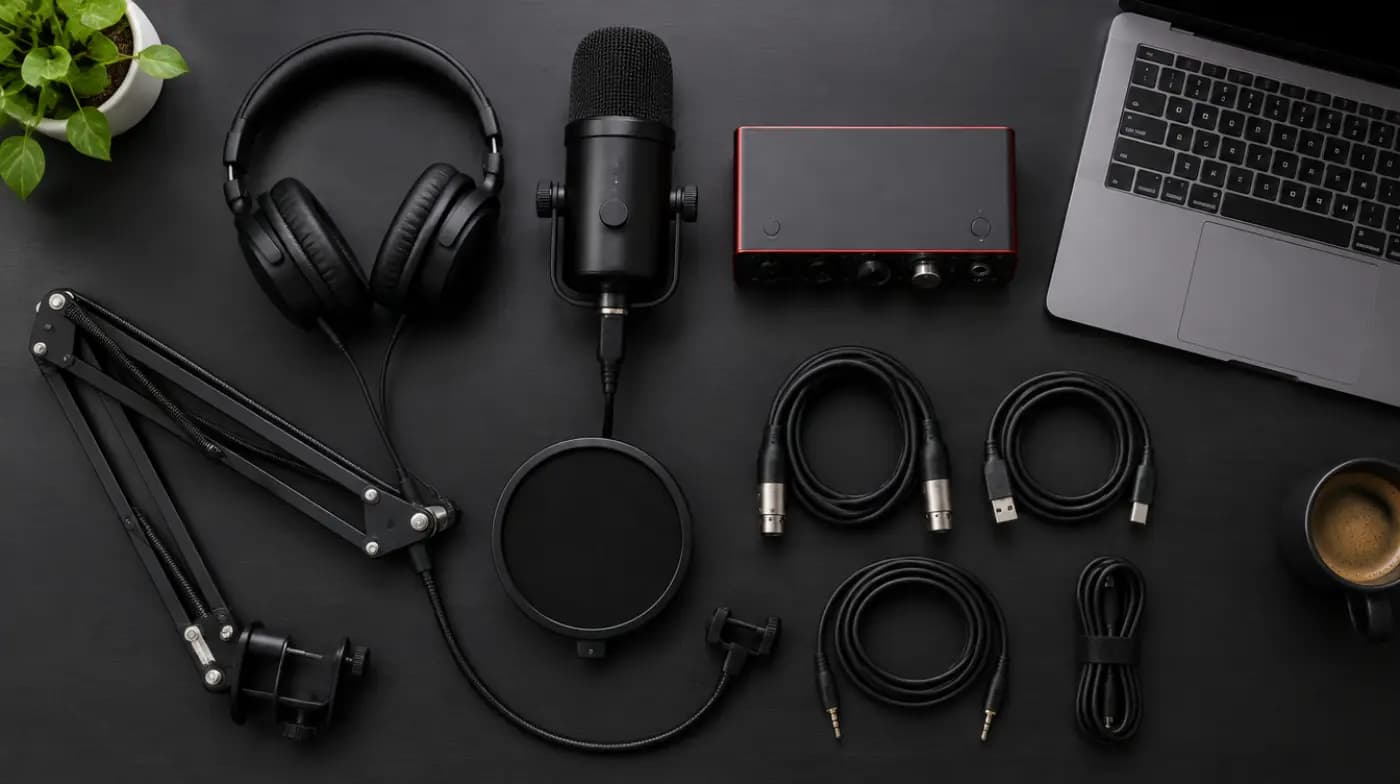
- Microphone. A dynamic USB microphone is the usual beginner pick. Dynamic mics pick up less room echo than condenser mics, which helps in untreated home rooms.
- Headphones. Closed-back headphones let you hear what you are recording without the sound leaking back into the mic.
- Recording software. Free options such as Audacity or GarageBand handle solo recording. For remote interviews, use a remote recording platform that records each person on their own track.
- A quiet, soft room. A small room with carpet, curtains, a bed or a closet full of clothes beats a large empty room with hard walls.
Start with those four and upgrade only when you know what is holding your sound back.
How do you start a podcast for free?
You can start a podcast for free and still sound acceptable. The trade-off is time and some sound quality, not the ability to publish.
| Setup | Microphone | Recording and editing | Hosting | What you trade off |
|---|---|---|---|---|
| Free | Phone voice memo app or a headset you already own | Audacity or GarageBand (free) | A free hosting plan, for example Spotify for Creators, which advertises "Host for free, distribute everywhere" | Thinner sound, more editing time, fewer analytics and features |
| Budget | Entry-level dynamic USB mic, basic closed-back headphones | Free editor or a low-cost remote recording plan | Free plan or an entry-level paid host | Little; most listeners will not hear the difference |
| Pro | XLR dynamic mic with an audio interface, a mic arm, some room treatment | Paid editing software or an editor you hire | Paid host with full analytics, multiple shows and team access | Money; worth it once the show has proven itself |
Prices change often and vary by brand, so we keep exact numbers in a separate breakdown of what it costs to start a podcast.
Tip: If you spend money anywhere, spend it on the microphone first. A decent mic in a quiet, soft room fixes more problems than any software can.
How do you record your first episode?
Before you hit record, write an outline. Most good episodes follow a simple shape: a hook, a short intro, three main points or questions, and a clear ending with one call to action. A script template with copy-ready versions for solo, interview and co-hosted shows saves a lot of time here.
Recording checklist:
- Turn off fans, air conditioning and notifications.
- Sit about a hand's width (a few inches) from a dynamic mic and speak across it rather than straight into it, which reduces popping sounds.
- Record 10 seconds of silence at the start. It helps noise reduction later.
- Do a test recording and listen back on headphones before the real take.
- If you stumble, pause, then repeat the whole sentence. It is far easier to cut cleanly.
For interviews, send guests a short prep note: what the show is about, the rough questions, and a request to use headphones and a quiet room. A prepared list of interview questions makes that note easy to write.
How do you edit a podcast?
Keep editing light at first. The goal is a clean, easy listen, not perfection.
- Cut false starts, long pauses and tangents that go nowhere.
- Even out volume so quiet and loud sections feel similar.
- Apply gentle noise reduction if there is a steady hum.
- Add your intro and outro.
- Export as an MP3 at the settings your host recommends.
A short, consistent intro helps listeners settle in. Keep it under 30 seconds: the show name, who it is for, and what this episode covers.
Many first-time podcasters over-edit and burn out. Give yourself a time limit per episode, such as no more than twice the episode's length.
What is podcast hosting and why do you need it?
A podcast host stores your audio files and generates your RSS feed. The RSS feed is what podcast apps read to show your episodes. You do not upload episodes to Apple Podcasts or Spotify directly; you upload them to your host, and the apps pick them up from the feed.
When you choose a host, compare:
- Free or paid plan, and any limits on uploads or storage.
- Analytics: downloads, apps and locations.
- Whether you can move your show to another host later with a redirect.
- Monetization options, if that matters to you.
Key takeaway: Your RSS feed is the real home of your podcast. Choose a host that lets you take that feed with you if you switch later.
How do you get your podcast on Apple Podcasts and Spotify?
Once your host has published at least one episode, you have a working RSS feed. Then:
- Apple Podcasts. Sign in to Apple Podcasts Connect, add a new show and paste your RSS feed URL. Apple lists at least one episode as a required part of a valid feed. Fill in your show details and submit for review.
- Spotify. Claim or submit your show through Spotify for Creators. If you host there, your show can appear on Spotify directly.
- Everywhere else. Many hosts offer one-click submission to other apps such as YouTube Music, Amazon Music and Pocket Casts. Use them.
Approval times vary, so submit a week or two before your public launch date.
How do you launch a podcast?
Launch with more than one episode. Three is a common choice: it gives a new listener enough to binge and decide whether to subscribe.
- Trailer. A one to two minute trailer explains who the show is for and what they will get.
- Launch week. Tell everyone you know personally, not just your social followers. A personal message gets more listens than a public post.
- Ask for ratings and follows. Early follows help new listeners trust the show.
- Guests share. If your launch episodes include guests, send each one a ready-to-post link, a short clip and a suggested caption.
How do you start a podcast with no audience?
Every podcast starts with zero listeners. The shows that grow do a few things well.
- Be findable. Use clear episode titles that match what people search, such as "How to ask for a raise in your first year" rather than "Episode 7."
- Borrow audiences. Interview guests who have their own following, and appear as a guest on other shows of a similar size.
- Repurpose. Turn each episode into short clips, a written summary or a newsletter.
- Join the community. Answer questions in the forums and groups where your listeners already spend time, and mention the show only when it genuinely helps.
Do one or two of these consistently rather than all of them occasionally.
What makes a successful podcast?
There is no single formula, but successful podcasts usually share four habits.
- Consistency. They publish on a predictable schedule, weekly or every other week, and stick to it.
- A clear promise. Listeners know what they will get from every episode.
- Good enough audio. Not studio grade, but no echo, clipping or distracting noise.
- Patience. They judge progress over months, not the first few episodes.
Pick one metric to watch early, such as the number of people who finish episodes or follow the show, rather than chasing total downloads.
How do you start a podcast and make money?
Making money from a podcast is possible, but it rarely comes first. Plan for the show to support something else before it pays for itself.
Common ways podcasts earn:
- Sponsorships and ad reads. Brands pay to be mentioned. If you read an ad, disclose the relationship; the FTC's endorsement guidance says that when an endorsement is made audibly, the disclosure should be made at least audibly.
- Listener support. Memberships, bonus episodes or paid subscriptions.
- Your own offers. Coaching, consulting, courses, books or products. For many niche shows this is the strongest model.
- Affiliate links. Commissions on products you genuinely use and recommend.
A small, highly targeted audience can be worth more to you than a large general one. A show with a few hundred listeners who are exactly your ideal clients can pay for itself through one new client.
What mistakes should beginner podcasters avoid?
- Buying gear before testing the idea. Record a few practice episodes on what you already own.
- Choosing a vague topic. If the show is for everyone, it is for no one.
- Long, rambling intros. Get to the point in the first minute.
- Skipping the schedule. Irregular episodes lose listeners.
- Giving up at episode 8. Many shows stop just before they would have started to find their audience.
Should you run an interview show with authors?
If you are a nonfiction author, starting your own podcast is one way to build an audience before or after a book launch. It is also a lot of ongoing work.
Many authors get more from appearing on established shows than from launching a new one. If that sounds like you, our guide on how to get on podcasts as a guest is a better starting point. If you would rather hand that process to someone else, our studio researches, pitches and schedules those interviews for authors.
If you do start your own show, the steps above are the same whatever your topic: choose a narrow niche, record a few episodes, get your feed onto Apple and Spotify, and keep publishing.