
Most stalled books don't have a writing problem. They have a planning problem: the author sat down to write chapter one without knowing what chapter seven needed to do.
A book outline template fixes that. Below are four free templates you can copy into any document, plus a short guide on how to write a book outline that actually gets used. They're built for nonfiction and memoir, but the chapter-level template works for any book.
What should a book outline template include?
Every useful outline, whatever the format, answers four questions:
- What does the book promise, and to whom? One sentence that every chapter has to serve.
- What are the chapters, in order? The path from the reader's starting point to the promised result.
- What does each chapter do? Two or three sentences per chapter.
- What goes inside each chapter? The main points, stories, examples and evidence.
Those four layers are what separate an outline from a list of chapter titles. The templates below all follow them.
| Template | Best for | Organized around |
|---|---|---|
| 1. Argument-led nonfiction | Business, idea-led, popular psychology | A central claim and supporting points |
| 2. How-to or prescriptive | Self-help, professional guides | Steps the reader follows |
| 3. Memoir | Personal stories, narrative nonfiction | Scenes, turning points and theme |
| 4. Chapter-level | Any book, used per chapter | Hook, sections, takeaway |
Template 1: Argument-led nonfiction book outline
Use this nonfiction book outline when your book makes a case: a new way to see a problem, a counterintuitive idea, or a framework that explains something. Copy it into your document and fill in the brackets.
BOOK OUTLINE: ARGUMENT-LED NONFICTION

Working title:
Subtitle (states the promise):
Reader (one specific person):
The problem they have:
Big idea (one sentence):
What readers will believe or do differently after reading:

INTRODUCTION
- Opening story or scene that shows the problem:
- Why the usual explanation or advice falls short:
- The big idea, stated plainly:
- Why the author is qualified to make this case:
- What's ahead (one line per part):

PART 1: THE PROBLEM
Chapter 1: [Title]
- Summary (2-3 sentences):
- Key point:
- Supporting evidence (research, data, interviews):
- Story or example:
- Takeaway:

Chapter 2: [Title]
- Summary:
- Key point:
- Supporting evidence:
- Story or example:
- Takeaway:

PART 2: THE IDEA
Chapter 3: [Title]
- Summary:
- Key point:
- Supporting evidence:
- Common objection and the answer to it:
- Takeaway:

Chapter 4-6: [Repeat structure]

PART 3: WHAT TO DO ABOUT IT
Chapter 7: [Title]
- Summary:
- How to apply the idea:
- Example of it working (hypothetical or real, cited):
- Takeaway:

Chapter 8-9: [Repeat structure]

CONCLUSION
- Return to the opening story:
- The big idea, restated with what the reader now knows:
- One action to take this week:

RESEARCH TO DO:
- [ ]
- [ ]
Tip: Write the "common objection" line for every argument chapter. If you can't name the strongest counterargument, readers will, and the chapter will feel one-sided.
Template 2: How-to or prescriptive book outline
Use this when your reader wants a result and your book is the process. Each chapter is one step, so the order matters more than anywhere else.
BOOK OUTLINE: HOW-TO / PRESCRIPTIVE

Working title:
Subtitle (result + timeframe or method):
Reader:
Where they are now:
Where they'll be after the book:
Number of steps in the method:

INTRODUCTION
- The reader's frustration, in their words:
- What they've already tried and why it didn't work:
- The method in one paragraph:
- How to use this book (read in order, exercises, worksheets):

CHAPTER 1: Before you start
- What the reader needs to know or have first:
- Quick self-assessment or starting checklist:

CHAPTER 2: Step 1 - [Name of step]
- Goal of this step:
- Why it comes first:
- How to do it (numbered sub-steps):
  1.
  2.
  3.
- Common mistakes:
- Example (hypothetical or cited):
- Exercise or worksheet:
- Sign you're ready for the next step:

CHAPTER 3: Step 2 - [Name of step]
- [Repeat structure]

CHAPTER 4-8: Steps 3-7
- [Repeat structure]

CHAPTER 9: Troubleshooting
- What to do if [common problem 1]:
- What to do if [common problem 2]:
- What to do if [common problem 3]:

CHAPTER 10: Keeping it going
- How to maintain the result:
- What to do next:

APPENDIX
- Templates, checklists, scripts:
- Resources and further reading:
The "sign you're ready for the next step" line is the one most authors skip. It's also what makes readers trust the method, because it tells them they're on track.
Template 3: Memoir outline template
A memoir is organized around scenes and change, not points. Use this template to map the arc before you draft. For the bigger picture, see our guide on how to write a memoir.
BOOK OUTLINE: MEMOIR

Working title:
Theme (what the story is really about):
Time frame covered:
Who I was at the start:
Who I am at the end:
What changed me:
Structure (chronological / frame / braided / thematic):

OPENING
- Opening scene (the moment that hooks the reader):
- What's at stake:
- Question the book will answer:

ACT 1: BEFORE
Chapter 1: [Title]
- Key scene:
- Setting, people, sensory details:
- What I wanted then:
- Reflection (what I understand now):

Chapter 2-3: [Repeat structure]

TURNING POINT
Chapter 4: [Title]
- The event that changed everything:
- Scene, in full:
- Immediate aftermath:

ACT 2: THE STRUGGLE
Chapter 5: [Title]
- Key scene:
- Obstacle or conflict:
- What I tried:
- What I got wrong:
- Reflection:

Chapter 6-9: [Repeat structure]

CLIMAX
Chapter 10: [Title]
- The moment of reckoning:
- The decision or realization:

ACT 3: AFTER
Chapter 11: [Title]
- Who I became:
- How the theme resolves:
- Final image or scene:

PEOPLE IN THIS BOOK
- Name / role / how they're portrayed / name changed? (Y/N):

SCENES I STILL NEED TO WRITE
- [ ]
- [ ]
The "people in this book" list helps when you revise. It shows at a glance who appears, how, and where you may need to take care with privacy.
Template 4: Chapter outline template
Use this chapter outline template for any book, once per chapter, after your book-level outline is done. It turns a chapter summary into a plan you can draft from in one or two sessions.
CHAPTER OUTLINE

Chapter number and working title:
Target length (words):
The one thing the reader should take from this chapter:
How it connects to the previous chapter:

1. OPENING HOOK
   - Story, scene, question or surprising fact:
   - Why the reader should care right now:

2. SECTION 1: [Heading]
   - Main point:
   - Explanation:
   - Example or story:
   - Evidence or source:

3. SECTION 2: [Heading]
   - Main point:
   - Explanation:
   - Example or story:
   - Evidence or source:

4. SECTION 3: [Heading]
   - Main point:
   - Explanation:
   - Example or story:
   - Evidence or source:

5. PRACTICAL APPLICATION
   - Exercise, checklist, action step or reflection question:

6. CLOSE
   - Summary in 2-3 sentences:
   - Bridge to the next chapter:

NOTES
- Stories to include:
- Research still needed:
- People to interview:
Template tip: Fill in "the one thing the reader should take from this chapter" before anything else. If you can't, the chapter isn't ready to outline, let alone write.
How do you write a book outline, step by step?
Templates give you the shape. Here's how to fill them in so the outline holds up through the draft.
- Write your promise. One sentence: who the book is for and what it gives them.
- Brain-dump everything. List every idea, story, lesson and point you might include. Don't sort yet.
- Group the ideas. Cluster related items. Each cluster is a possible chapter.
- Put the chapters in order. Arrange them in the order the reader needs them, not the order you thought of them.
- Cut what doesn't serve the promise. Anything that doesn't move the reader toward the result goes in a "maybe later" file.
- Summarize each chapter. Two or three sentences each. If you can't, the chapter isn't clear yet.
- Add bullets inside each chapter. Stories, evidence, examples and takeaways.
- Mark the gaps. Flag what you still need to research or remember.
- Test it. Read only the chapter summaries in order. They should tell the story of the whole book.
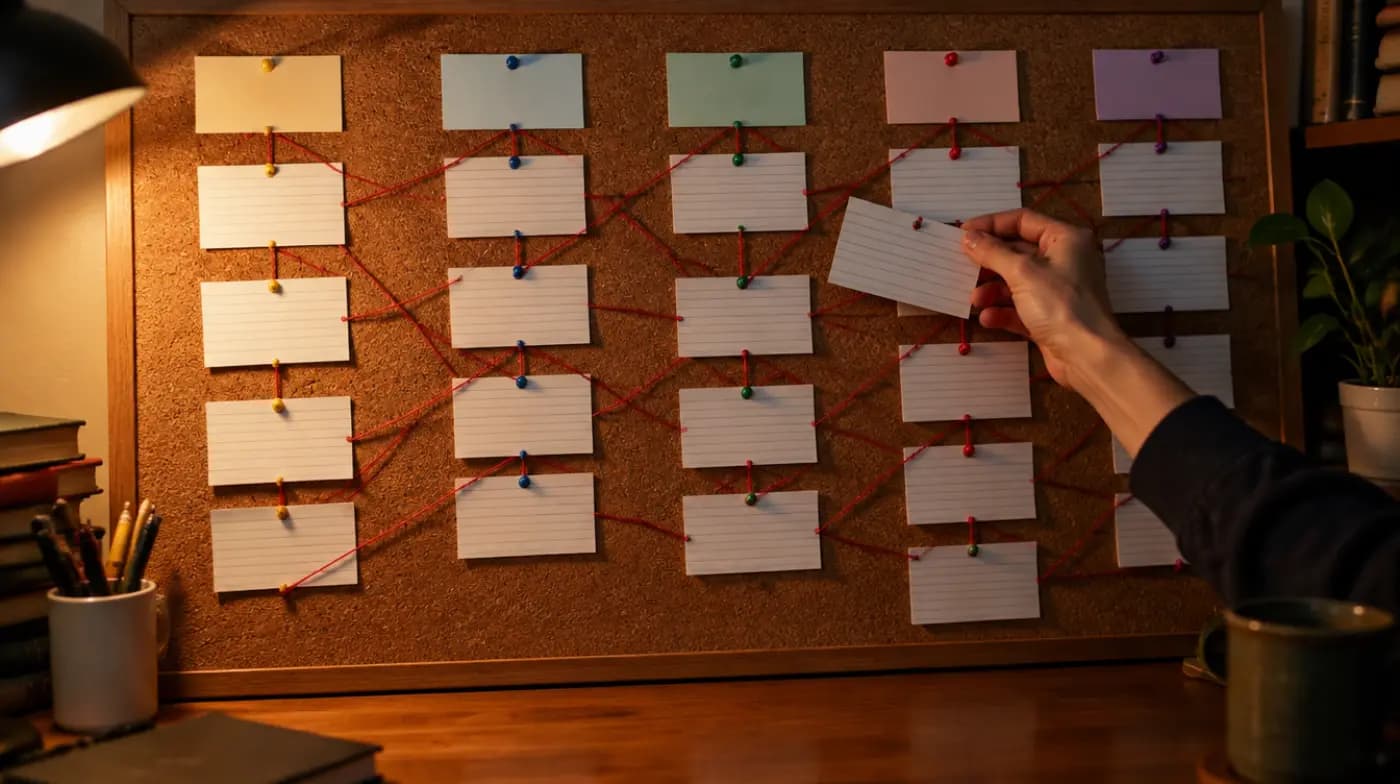
Many authors do steps 2 to 4 with sticky notes or index cards on a wall, because it's easier to move ideas around physically. Once the order holds, move it into one of the templates above.
How long should a book outline be?
Long enough to write from. A book-level outline is often a few pages; with chapter-level outlines added, it can run much longer.
The test is practical: when you sit down to write, can you start within five minutes? If not, that chapter's outline needs more detail. For more on how planning speeds up the whole project, see how long it takes to write a book.
Can your outline double as a book proposal outline?
Yes, mostly. If you're pitching a nonfiction book to agents or publishers, the proposal includes a chapter-by-chapter outline with a short summary of each chapter. Jane Friedman's proposal guide lists the chapter outline as one of the core sections.
The proposal version is written to sell, so each summary should make the chapter sound worth reading, not just describe it. Our guide to writing a book proposal shows how to adapt your outline for that.
What are common book outline mistakes?
- Outlining topics, not points. "Chapter 3: Marketing" is a topic. "Chapter 3: Why most authors market to the wrong reader" is a point.
- Too many chapters doing the same job. If two chapter summaries sound alike, merge them.
- No arc. The reader should be somewhere different by the last chapter.
- Treating the outline as fixed. It's a plan, not a contract. Update it when the draft teaches you something.
- Over-outlining. Spending months perfecting an outline is another way to avoid drafting.
What should you do after outlining?
Start drafting. Pick the chapter you know best, open its chapter-level outline and write the opening hook. The outline has already done the hard thinking.
For the full process from outline to published book, read our guide to writing a nonfiction book.