
Editing is usually the biggest single cost of getting a book ready for readers, and the quotes can look random at first. One editor quotes $1,500, another $6,000, for what sounds like the same job.
Usually it isn't the same job. So how much does a book editor cost for your book? This guide breaks down the rates for each type of edit, what each editor actually does, and how to find, test and hire the right one.
How much does a book editor cost?
The most widely used US benchmark is the Editorial Freelancers Association 2026 rate chart, based on a survey of more than 1,100 EFA members about rates they charged in 2025. Here are its median ranges for general nonfiction, applied to a 60,000-word book:
| Type of edit | What it covers | EFA median rate (nonfiction) | 60,000-word book |
|---|---|---|---|
| Manuscript assessment | Written report on big-picture strengths and problems | 1.5–1.8¢ per word | $900–$1,080 |
| Developmental edit | Structure, argument, organization, gaps | 4.0–5.0¢ per word | $2,400–$3,000 |
| Line edit | Clarity, flow, voice, sentence by sentence | 3.5–5.0¢ per word | $2,100–$3,000 |
| Copyedit | Grammar, consistency, usage, style | 3.0–4.0¢ per word | $1,800–$2,400 |
| Proofreading | Final typos and layout errors | 2.0–3.0¢ per word | $1,200–$1,800 |
Rates vary by category. In the same chart, the median developmental edit for business and marketing books is 4.5 to 6.0 cents a word, for memoirs 3.5 to 4.5 cents, and for fiction 3.0 to 3.5 cents. Fiction copyediting runs 2.0 to 2.7 cents a word, a little below nonfiction.
Some editors charge by the hour instead. The EFA's median hourly ranges for nonfiction are $57.50 to $70 for developmental editing and $45 to $60 for copyediting.
Key takeaway: The type of edit matters more than the editor's price list. A $1,500 copyedit and a $3,000 developmental edit aren't competing quotes; they're different services.
Reedsy's 2026 cost guide, based on quotes from its own marketplace, gives similar averages for an 80,000-word book: $2,880 for a developmental edit, $2,160 for a copyedit and $1,600 for proofreading.
What does a book editor do?
A book editor improves your manuscript at one of several levels, from the whole shape of the book down to individual commas. Most editors specialize in one or two levels, so it helps to know which one you need.
Developmental editing
A developmental editor reads the whole book as a reader and an architect. They look at whether the argument holds, whether chapters are in the right order, what's missing and what should be cut.
You typically get an editorial letter of several pages plus comments in the manuscript. Expect to do significant rewriting afterward.
Line editing
A line editor works paragraph by paragraph. The focus is on how the writing reads: tightening wordy sentences, smoothing transitions, cutting repetition and keeping your voice consistent.
Copyediting
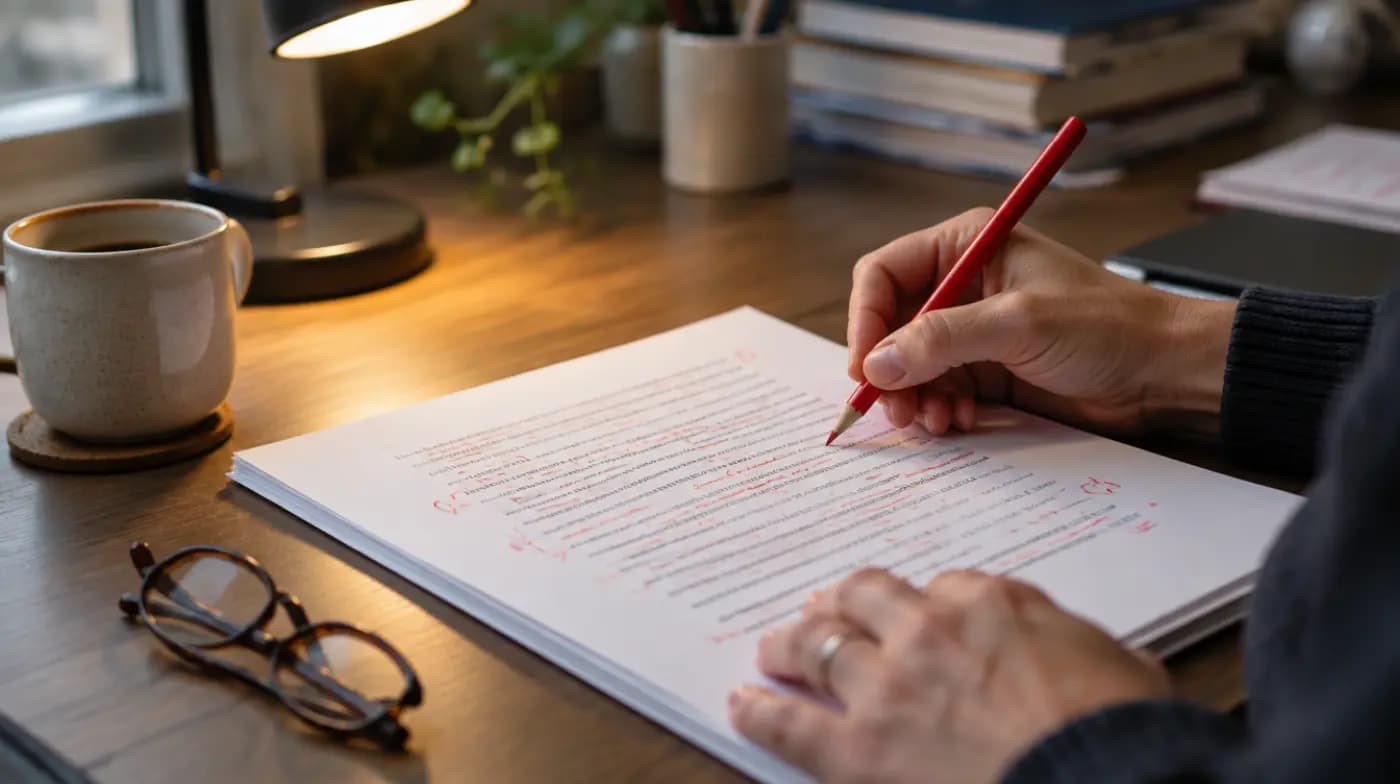
A copyeditor makes the text correct and consistent. That covers grammar, punctuation, spelling, word usage, capitalization, number style and internal consistency, usually following a style guide such as The Chicago Manual of Style. Copyeditors also flag factual questions and unclear passages.
Proofreading
A proofreader checks the final, formatted pages before publication. They catch typos that slipped through, plus layout problems such as bad line breaks, missing page numbers and inconsistent headers.
Tip: Do the edits in order. Paying for a copyedit before a developmental edit wastes money, because many of those corrected sentences will be rewritten or cut.
What affects book editing cost?
Two books of the same length can get very different quotes. The main factors:
- Word count. Most editors price per word, so length drives cost directly.
- Type of edit. Deeper edits take more time per page.
- The state of your draft. A clean draft moves faster. Many editors look at a sample before quoting for this reason.
- Subject matter. Technical, medical, legal and academic books commonly cost more because they need specialist knowledge.
- Turnaround. Rush jobs usually carry a surcharge.
- Experience. Editors with traditional publishing backgrounds or long track records in your category tend to charge more.
- Number of rounds. Ask whether a second pass or follow-up questions are included.
Editing is only one part of the total budget. Our guide to the full cost of publishing a book covers cover design, formatting, ISBNs and marketing as well.
How long does book editing take?
Editing time follows the same logic as cost: deeper edits take longer per page. The EFA chart measures pages at 250 words each and reports median editing speeds for nonfiction of about 4 to 8 pages an hour for developmental editing, 5 to 9 for copyediting and 7 to 12 for proofreading.
For a 60,000-word book, that is 240 manuscript pages. A copyedit at those speeds works out to roughly 27 to 48 hours of focused work, and a developmental edit to roughly 30 to 60 hours.
Editors rarely work on one book full time, so calendar time is longer. Ask each editor for a delivery date, and plan for:
- Booking lead time, since experienced editors are often scheduled weeks or months ahead.
- Your own revision time between rounds, which is often longer than the edit itself.
- A final proofread after formatting, not before.
How do you find a book editor?
Good editors are rarely the ones who advertise most. Here is how to find a book editor who knows your kind of book:
- Professional associations. The EFA runs a free member directory and job list you can filter by skill, subject and genre.
- Acknowledgments pages. Authors often thank their editors by name. Look in books similar to yours.
- Author communities. Ask authors in your category whom they hired and whether they would hire them again.
- Freelance marketplaces that vet editors and show past work.
- Referrals from other professionals, such as cover designers, book coaches or agents.
Make a shortlist of three to five editors who have edited books in your category and at the level of edit you need.
How do you vet a book editor before hiring?
Once you have a shortlist, check each editor the same way.
Ask for a sample edit
Many editors offer a short sample edit of a few pages, sometimes free and sometimes for a small fee. It is the single best test you can run.
Send every candidate the same passage, ideally a section you know isn't working. Then compare:
- Did they fix problems you didn't know were there?
- Do their comments explain why, so you learn something?
- Does the edited version still sound like you?
- Did they flag questions rather than silently rewrite?
Check their background
Ask which books they've edited, in which categories, and at what level. Ask for one or two author references and actually contact them.
Get a written agreement
A clear agreement should cover:
- The type of edit and exactly what's included.
- The price and how it's calculated, plus any cap if billing hourly.
- Deadlines for both of you.
- Payment schedule, commonly a deposit with the balance on delivery.
- Whether follow-up questions or a second pass are included.
- Confirmation that you keep all rights to your work.
Template: Use a short inquiry email so editors can quote accurately.
Subject: Editing inquiry: [type of edit] for a [word count]-word [category] book

Hi [Name],

I'm looking for a [developmental edit / copyedit / proofread] for my
[category] book, [working title], about [one-sentence summary].
The manuscript is [word count] words and is [complete / in revision].

I'm aiming to have edits back by [date]. Could you let me know your
availability, your rate for this project, and whether you offer a
sample edit? I can send the first [number] pages.

Thanks,
[Your name]
What are the red flags when hiring a book editor?
Most freelance editors are honest professionals. Walk away from anyone who:
- Guarantees publication, an agent or bestseller status. No editor controls those outcomes.
- Won't do a sample or show past work. You should be able to see how they edit before you commit.
- Quotes without seeing the manuscript for a developmental or line edit.
- Rewrites everything in their own voice. Good editing makes your book sound more like you, not less.
- Asks for full payment up front on a large project without a clear contract.
- Was referred by a publisher or agent who profits from the referral. Writer Beware has documented agents and publishers that steer authors to paid services without disclosing their financial ties.
- Has prices far below the market. Very cheap editing is often light, rushed or done by someone without training.
Do you need a book editor if you're traditionally published?
If you sign with a traditional publisher, the publisher pays for editing. Your acquiring editor usually handles the big-picture edit, and the publisher hires copyeditors and proofreaders.
Some authors still pay a freelance editor before submitting to agents, especially for a first book or a nonfiction proposal. It's optional, and a polished proposal often matters more than a polished full manuscript. Our guide on how to write a book proposal explains what agents look for.
If you're self-publishing, the editor is one of your most important hires. See our step-by-step guide on how to publish a book for where editing fits in the full process.
What comes after the edit?
A well-edited book is ready for design, formatting and launch. That's also when you should start lining up readers, because launch planning commonly begins months before publication.
For self-published nonfiction authors, podcast interviews are one practical way to reach readers without a publisher's publicity team. Our page for self-published authors explains how we help with that.